Top 10 AI Marketing Apps & Benefits – Power of Artificial Intelligence
3 years agoWhat Is Viral Marketing? Strategy, Examples & the 2026 Playbook
3 months ago -
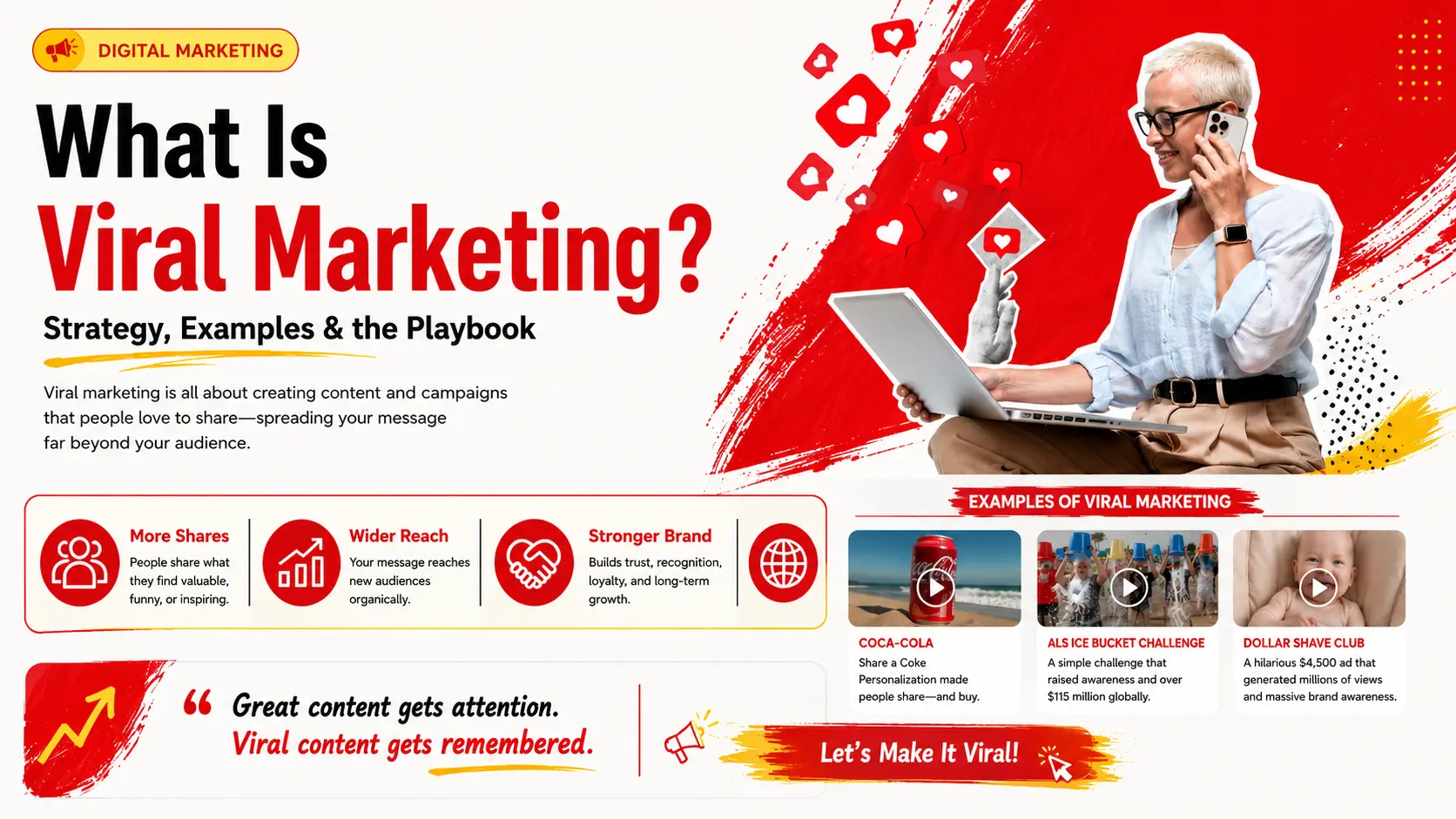
Viral marketing is a promotion strategy where people want to share a brand’s message by sharing content with friends, followers, and communities instead of the brand itself. Brands use this viral marketing strategy to reach a larger audience who will spread your brand’s voice. For each viewer, the brand creates something so emotional, useful, or entertaining that sharing feels natural. Each share exposes new audiences, multiplying reach exponentially – like a virus spreads – at little or not paying any distribution cost.
Table of Contents
What is Viral Marketing?
Viral marketing is a strategy in which content spreads because people choose to share it, multiplying reach person-to-person rather than ad-dollar-by-ad-dollar. One share becomes ten, ten become a thousand, and the audience does the distribution for you. That’s the whole trick, and almost everyone gets it wrong.
They get it wrong because they treat virality as luck. I’ve run social campaigns for almost 100+ brands over six years, and the content that spread never spread by accident. It hit a specific emotional trigger, at a specific moment, in a format the platform wanted to push. Luck picks the winner; the mechanics decide who gets a ticket.
This guide covers those mechanics: what makes people share, the campaign types that still work, real examples with the numbers, and a strategy you can repeat.
How viral marketing actually works
Every viral spread follows the same loop: a person sees the content, feels something strong enough to act on it, shares it where their people are, and each share restarts the loop with a fresh audience. Marketers call the multiplication rate the K-factor. If every 100 viewers generate 120 new viewers through shares, K is 1.2 and the content compounds. Below 1.0, the loop decays and the content dies quietly, which is what happens to almost everything posted online.
The lever you control is the middle of the loop: the feeling. Nobody shares content because a brand asked. They share because the content says something about them.
The psychology behind why people share
Wharton professor Jonah Berger studied thousands of viral hits and found six drivers behind sharing, summarized as STEPPS. I use it as a pre-publish checklist, and content ticking three or more of these boxes consistently outperforms:
- Social currency: Sharing it makes the sharer look smart, funny, or in the know.
- Triggers: The content attaches to something people encounter often, so it keeps resurfacing.
- Emotion: High-arousal feelings travel: awe, amusement, anger. Mild contentment stays put.
- Public: Visible behavior gets copied. Challenges and formats spread because participation can be seen.
- Practical value: Useful things get forwarded. “Send this to someone who needs it” is a share engine.
- Stories: People retell narratives, and the brand rides inside the narrative.

Types of viral marketing
Emotional content campaigns: One asset engineered around a single strong feeling. Dollar Shave Club’s 2012 launch video cost about $4,500, pulled 12,000 orders in 48 hours, and started the run that ended in a $1 billion acquisition.
Challenges and participation loops: The audience creates the next wave of content. The ALS Ice Bucket Challenge raised over $115 million in a summer because the format demanded a public post and three nominations: a built-in K-factor above 1.
Trend-jacking: Riding a moment already moving. Ocean Spray didn’t plan the skateboarding cranberry-juice TikTok in 2020, but reacting within days, gifting the creator a truck instead of a takedown notice, turned someone else’s moment into their brand story.
Personality-led brand accounts: Duolingo’s unhinged owl turned a study app into a TikTok character with millions of followers. The product barely appears; the personality does the spreading.
Ritualized data moments: Spotify Wrapped manufactures virality on schedule every December by handing users social currency about themselves. Same mechanics, zero luck.
Meme formats and buzz tactics get their own treatment in the meme marketing and buzz marketing guides, and the full campaign breakdowns live in viral marketing examples.
10 examples of viral marketing campaigns from top brands
Study these ten campaigns and one thing stops being surprising: none of them were accidents. Each one engineered a specific share trigger, and the trigger is listed with every example so you can steal it.
1. Old Spice — The Man Your Man Could Smell Like (2010)
One shirtless spokesman, one absurd continuous shot, and a follow-up stunt where the character filmed 180+ personalized video replies to commenters in real time. Sales of the featured product jumped sharply in the months after launch. Trigger: humor plus direct audience participation.
2. Blendtec — Will It Blend? (2006)
A blender company blended iPhones, marbles, and golf balls on camera. Production cost per video: almost nothing. The series ran for years and multiplied sales several times over. Trigger: curiosity you can’t look away from, applied to a boring product.
3. Red Bull — Stratos (2012)
Felix Baumgartner jumped from the edge of space, and roughly 8 million people watched the YouTube livestream at once, a record then. No product in the frame, and the brand association couldn’t be stronger. Trigger: awe at a scale no competitor could copy.
4. Oreo — Dunk in the Dark (2013)
The Super Bowl blackout hit, and within minutes Oreo tweeted a dim image captioned “You can still dunk in the dark.” One tweet out-earned brands that paid millions for ad slots that night. Trigger: perfect timing on a moment every viewer was already living.
5. ALS Association — Ice Bucket Challenge (2014)
Dump ice water on yourself, post it, nominate three friends. The nomination rule built a K-factor above 1 into the format itself, and the campaign raised over $115 million in one summer. Trigger: public participation with a social obligation attached.
6. Coca-Cola — Share a Coke (2011)
Coke swapped its logo for first names, and people hunted store shelves for themselves and their friends. Launched in Australia, rolled out worldwide, credited with reversing a long sales slide among young drinkers. Trigger: personalization that turns a product into a message between two people.
7. Wendy’s — #NuggsForCarter (2017)
A teenager asked how many retweets would earn free nuggets for a year. Wendy’s answered “18 million,” and the internet pushed his tweet to about 3.4 million retweets, the most-retweeted post in the world at the time. Wendy’s paid out anyway. Trigger: a public challenge the crowd could win together.
8. e.l.f. Cosmetics — Eyes. Lips. Face. (2019)
A budget beauty brand commissioned an original song for TikTok and let creators run with it. The hashtag pulled billions of views, the song charted, and e.l.f. became the case study every brand pitched for two years. Trigger: handing the audience a soundtrack instead of an ad.
9. Barbie — the 2023 movie blitz
The selfie generator let anyone put themselves on a Barbie poster, and millions did, flooding every feed with self-made ads. Combined with pink takeovers of everything from burgers to real estate listings, the campaign carried the film past $1.4 billion. Trigger: a self-expression tool people used on themselves.
10. Stanley — the burned car tumbler (2023)
A woman’s car burned; her Stanley cup survived with ice still inside, and her TikTok showing it passed tens of millions of views. Stanley’s president replied on video and bought her a new car. The Quencher went from steady seller to cultural object, and revenue multiplied within the year. Trigger: an unplanned proof moment, answered fast and generously. Same playbook as Ocean Spray above: the brand didn’t create the moment, it refused to waste it.
How can a campaign go viral?
A campaign goes viral when five conditions line up: a high-arousal emotion, frictionless sharing, the right cultural moment, a seed audience dense enough to ignite, and a hook that invites participation. Miss one and the loop usually stalls. Look back at the ten examples and check them against the list:
- Emotional charge. Each campaign above elicits awe, laughter, surprise, or a sense of belonging within seconds. Informative-but-flat content gets nods, not shares.
- Zero-friction sharing. One tap, one hashtag, one sound. The Ice Bucket format fit in a sentence; if the pitch needs a paragraph, the share dies in explanation.
- A moment already moving. Oreo and Stanley didn’t manufacture attention; they attached to attention that existed. Timing beats budget in almost every case above.
- The right first audience. Virality ignites in dense communities and spills outward. e.l.f. seeded TikTok creators, not TV viewers. A thousand true fans in one niche outperform a million scattered impressions.
- A participation hook. Nominate three friends. Put your name on the bottle. Make your own poster. The audience must have something to do, because doers become distributors.
Treat these five as a launch gate: if a campaign can’t answer all five before publishing, fix the concept, not the caption.
How to make a viral marketing strategy
You can’t force virality, but you can raise its probability the same way you raise any conversion rate: structure, volume, and iteration.
- Pick one emotion per asset: Awe, laughter, or righteous anger. Content aiming at two feelings lands neither.
- Design the share before the content: Write the caption your viewer would use when reposting. If you can’t write it, they can’t either.
- Go platform-native: A TikTok that looks like an ad dies in three seconds. Lo-fi beats polished on every 2026 feed, and vertical video is the default, not an adaptation.
- Hook inside two seconds: The scroll decides before the content plays. Pattern interrupts, bold claims, or mid-action openings.
- Ship volume: Post one asset, and you’re gambling. Post thirty variations, and you’re running an experiment. Winners get remade, losers teach.
- Prepare the landing: Virality without a next step is a bonfire. Please pin the follow-up, ready the offer, and brief support before you light the match.
Advantages and disadvantages of viral marketing
| Advantages | Disadvantages |
|---|---|
| Reach grows without matching ad spend; sharing does the distribution | Outcomes are unpredictable; most attempts never take off |
| Peer recommendation carries trust no ad can buy | You lose control of the message once it spreads |
| Brand awareness compounds fast, sometimes in days | Viral views rarely convert to sales on their own |
| Earned media and backlinks follow big campaigns | Backlash spreads by the same mechanics as praise |
The honest summary: viral marketing is the cheapest reach and the most expensive dependence. Brands that treat it as a lottery ticket burn budgets chasing lightning. Brands that treat it as a repeatable content discipline collect the wins as a bonus on top of a system that works anyway.
What’s different in 2026
Three shifts changed the playbook. First, discovery moved: nearly a third of consumers now start searches on TikTok, Instagram, or YouTube instead of Google, so viral content doubles as search visibility. Second, the aesthetic inverted: raw, low-production, human content outperforms polished content across every platform, leveling the field for small teams. Third, distribution narrowed: micro-communities and niche creators spread content deeper than broad blasts, so a thousand true fans in one subculture beat a million passive impressions.
And AI sits under all of it, generating variations, predicting hooks, and personalizing at volume no human team matches. The current landscape gets a yearly refresh in viral marketing trends.
AI tools for viral marketing
AI tools don’t make content go viral. It compresses the two things that do: volume and iteration speed. The stack I run for client campaigns, by job:
- Hook and script generation — ChatGPT, Claude. Feed a winning post and ask for 20 hook variations. The value is testing volume, not the first draft; publish nothing unedited.
- Trend detection — vidIQ, Google Trends. vidIQ surfaces rising YouTube topics and outlier videos before they peak; Trends confirms whether a spike is a platform bubble or real search demand. Catching a trend on day two instead of day five is the whole game in trend-jacking.
- Video production — CapCut, Runway, Higgsfield. Auto-captions, cutdowns, and AI-generated b-roll turn one shoot into fifteen platform-native clips. Captions matter more than polish: most feed video plays on mute.
- Design at volume — Canva Magic Studio. Thirty thumbnail and carousel variations in the time manual design produces three. Volume is what makes the testing loop in the strategy section possible.
- Virality prediction — emerging scoring tools. Some platforms now score a video’s hook strength and engagement potential before you post. Treat scores as a pre-flight check against the five conditions above, never as a green light.
The trap: AI makes average content cheap, so feeds drown in it, and the lo-fi human content from the 2026 section stands out more, not less. Use AI for the volume layer and keep a person on the judgment layer: which emotion, which moment, which community.
Measuring whether it worked
Views are the vanity layer. Track the loop instead: share rate (shares per view), K-factor, traffic and follower retention two weeks after the spike, and conversions attributed to the viral window. A campaign with 2 million views and zero sales failed. A campaign with 80,000 views and 400 customers won. Judge the loop by what it leaves behind.
FAQs
What is viral marketing in simple words?
Making content people want to share, so the audience spreads your message for you instead of you paying to show it to each person.
Is viral marketing free?
The distribution is free; the attempt isn’t. Production, creator partnerships, and the volume of content needed to find a winner all cost time or money. What virality removes is the per-impression cost of reach.
How long does viral content last?
The spike usually burns out in 3 to 10 days. The residue lasts longer: followers, backlinks, search demand for your brand name. Plan for the residue, because the spike never pays the bills by itself.
Can small businesses do viral marketing?
Small businesses win at it more often per dollar than big brands, because 2026 platforms reward authentic, low-production content and niche communities. A phone camera, a distinct personality, and posting consistency beat a six-figure production budget on TikTok regularly.
- How to Learn Digital Marketing Online FREE – Get Certified
- What Is Viral Marketing? Strategy, Examples & the 2026 Playbook
- 6 Free Best SEO Tools & Automated SEO Tools for Websites
- How to Write AI Video Generation Prompts Like a Pro?

Popular Post
![[2026 Updated] Top 10 Digital Marketing Agencies in Nepal Ranked!](https://mysticrubs.com/wp-content/uploads/2022/05/top-10-digital-marketing-company-in-nepal.png)
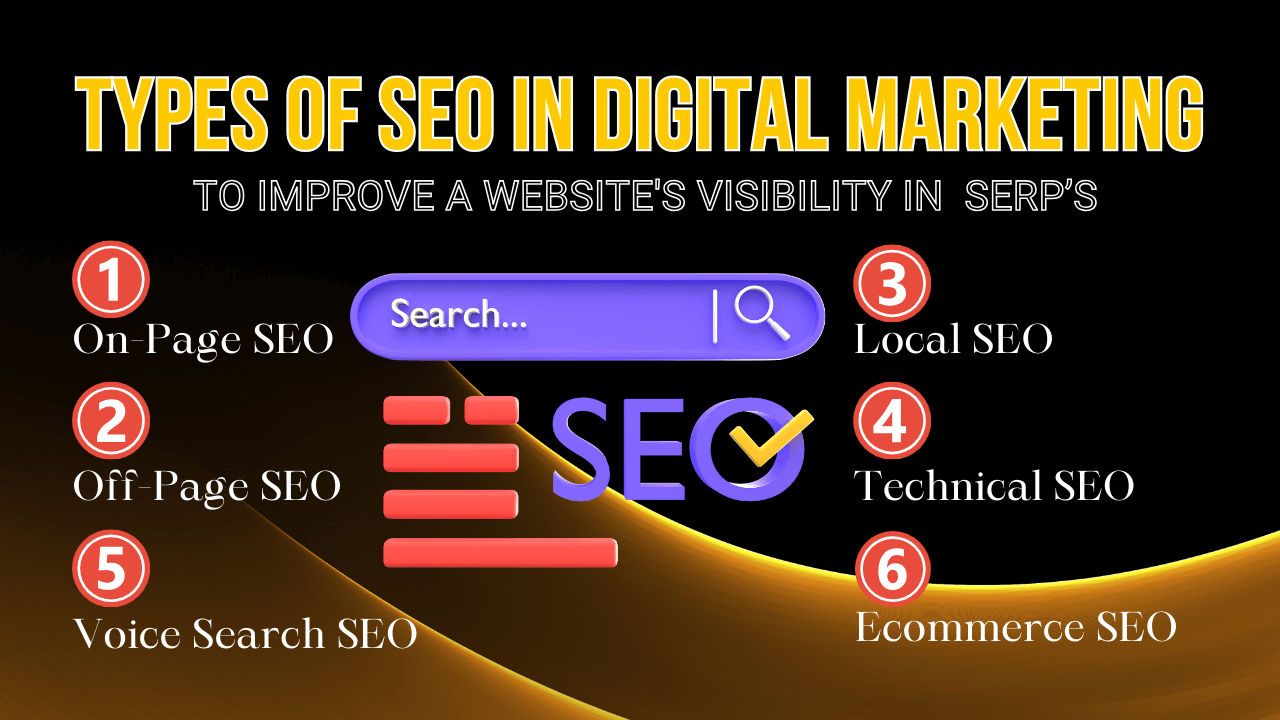
What Are the Types of SEO in Digital Marketing?
3 years ago


100% Best FREE SEO TOOLS 2026 for SEO Ranking
5 years ago