Top 10 AI Marketing Apps & Benefits – Power of Artificial Intelligence
3 years agoHow to Use AI in Marketing: 35 Free AI Marketing Tools for Small Businesses in Nepal
3 months ago -
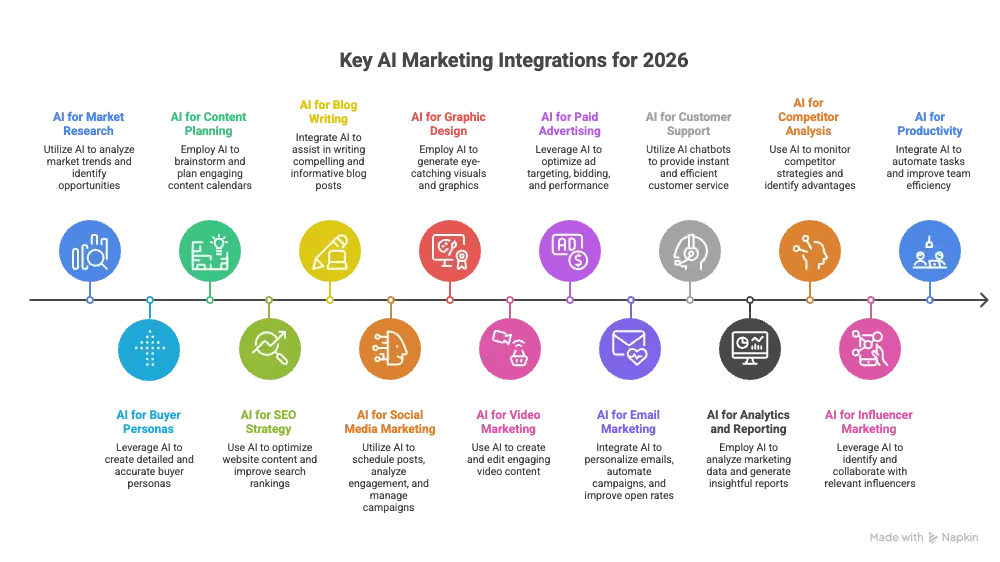
How do you use AI in marketing? You use AI Marketing Tools for Small Business in Nepal to speed up research, content, SEO, ads, email, and reporting — while humans keep control of strategy and brand voice. The simplest formula is human strategy + AI execution: pick one task (like blog outlines or ad variations), choose one tool, build a repeatable workflow, then measure and expand. This guide covers 35 AI tools for marketing strategy and exactly where each fits.
Artificial Intelligence (AI) has moved from being a futuristic concept to becoming one of the most practical tools in modern online business. In digital marketing, AI tools for marketing strategy are helping brands create content faster, improve customer experiences, analyze data more accurately, and generate better results with fewer resources.
Whether you run a startup, an e-commerce business, a service company, agency, or local brand, AI can transform the way you market online.
But there is one important question many businesses still ask: How do you use AI tools in a marketing strategy?
Table of Contents
How Can AI Help in Marketing?
AI helps in marketing by automating repetitive work, analyzing customer data, and generating content at scale. It accelerates market research, content creation, SEO, paid-ad testing, email personalization, and analytics – letting small teams produce results that once needed a full department. The six biggest gains are:
- Save time — blogs, captions, and reports drop from hours to minutes
- Reduce costs — small teams match large-department output
- Consistent content — same voice and pace across channels
- Better decisions — pattern analysis of behavior and campaign data
- Personalization at scale — right message, right audience, right time
- Competitive speed — move faster than manual-only competitors
As of 2026, 87% of marketers use AI in at least one workflow – up from 51% in 2024 (Salesforce State of Marketing).
What Are AI Marketing Tools?
AI marketing tools are software platforms developed by machine learning, natural language processing, predictive analytics, and automation systems that help marketers complete tasks faster and more intelligently.
These tools can support many marketing functions, such as:
- Social media management
- SEO optimization
- Graphic Design
- Content Planning
- Customer support
- Ad creation
- Lead generation
- Email marketing
- Analytics reporting
- Competitor research
- Workflow automation
Best AI Tools for Marketing Strategy
The best AI tools for marketing strategy in 2026 are:
- ChatGPT — best overall for strategy, content, and ideation
- Claude — best for long-form writing and SEO briefs
- Semrush / Ahrefs — best for keyword research and competitor data
- Surfer SEO — best for content optimization
- Canva AI — best for fast design and social creatives
- HubSpot AI — best all-in-one for CRM-driven marketing
AI Marketing Tools for Small Businesses in Nepal
AI marketing tools for small businesses are affordable, low-learning-curve platforms that cover core marketing without a big team or budget. Recommended starter stack:
- ChatGPT (free/Plus) — content, emails, ideas
- Canva AI (free) — posts, banners, ads
- Metricool (free tier) — schedule and track social
- Tidio AI — website chat and lead capture
- Mailchimp AI — email campaigns and subject lines
A small business can run a complete marketing strategy on these five for under the cost of one part-time hire.
AI isn’t just for big brands: 51% of small businesses now use AI, and 43% use AI marketing automation tools — up 13 points in a year (U.S. Chamber of Commerce Small Business AI Index, 2026).
Examples of popular AI tools for marketing:
- ChatGPT
- Claude
- Jasper AI
- Canva AI
- Surfer SEO
- Copy.ai
- HubSpot AI
- Meta AI for MCP
- Notion AI
- BuzzSumo
- Metricool
- Looker Studio
- NotebookLM Google
- Napkin AI
- Sora 2 AI
- Hailuo AI (Chinese app)
- Kling 01 and 2.6 (Chinese app)
- Seedance 1.5 Pro
- WAN 2.6 (Chinese app)
- Meta AI
- Grok AI
- Flow (veo 3.1) by Google
- InVideo
- Synthesia
- Mailchimp AI
- Intercom AI – Best for AI Chatbots
- Freshdesk AI – Best for Smart Ticketing
- Tidio AI – Best for Small Businesses
- Semrush AI
- Ahrefs
- Similarweb
- HypeAuditor for Influencer marketing
- Upfluence for Influencer Marketing
- Sprout Social AI Influencer marketing
- ClickUp AI for productivity and Team Operations
Why AI Matters in Marketing Today
Marketing has become more competitive than ever in Nepal. Customers expect fast responses, personalized experiences, fresh content, and consistent communication.
Traditional marketing methods often struggle because they require too much manual work.
AI Marketing Tools for Small Business in Nepal help solve this problem.
Benefits of Using AI Tools for Marketing Strategy
1. Save Time
Tasks that used to take hours, such as writing blogs, creating captions, or analyzing reports, can now take minutes.
2. Reduce Costs
Small teams can produce results that once required large departments.
3. Improve Content Production
AI helps maintain consistency and speed across channels.
4. Better Decision Making
AI tools can analyze patterns in customer behavior and campaign performance.
5. Personalization at Scale
Provide the right message to the target audience at the scheduled time.
6. Competitive Advantage
Businesses using AI often move faster than those relying only on manual processes.
The Right Way to Think About AI
AI Marketing Tools for Small Business in Nepal should not replace human marketing strategy.
Instead:
- Humans create vision
- Humans understand emotion
- Humans make brand decisions
- AI speeds execution
- AI improves efficiency
- AI handles repetitive tasks
The best formula of AI tools for Marketing Strategy is:
Human strategy + AI execution = Better marketing performance
How to Use AI in Marketing: 15 Steps (Step-by-Step)
1. Use AI Tools for Market Research
Every successful campaign starts with understanding your audience. AI Marketing Tools for Small Business in Nepal can help you gather insights quickly.
What AI Can Help You Discover
- Customer pain points
- Frequently asked questions
- Industry trends
- Buying motivations
- Audience interests
- Competitor messaging
- Search behavior
Tools to Use for Marketing
- ChatGPT
- Claude
- BuzzSumo
- Google Trends
- Semrush
- Ahrefs
Also Read: Top 10 AI Marketing Apps & Benefits
Example Prompts
- What are the common problems and solutions faced by restaurant owners in Nepal?
- What content performs best in the makeup product industry?
- What are the trending topics in e-commerce marketing this month?
When you know what your audience wants, your campaigns become more effective.
2. Use AI for Building Buyer Personas
Many businesses market too widely. AI Marketing Tools for Small Business in Nepal help create targeted customer personas faster.
Example Persona
Name: Busy Professional Renu
- Age: 28- 40
- Uses Instagram daily
- Values convenience
- Limited time
- Will pay for premium solutions
- Responds to clear, practical messaging
Example Prompts for Building Buyer Personas
Ask AI: “Create 3 buyer personas for a makeup products brand targeting women in cities in Nepal.”
Better personas = Better targeting, Better messaging, Better conversions.
3. Use AI Tools for Content Planning
Consistency is key in marketing. AI tools can create monthly content calendars, itinerary plans, scripts, emails, and blog posts in minutes.
Ask AI to Generate:
- 30-day Instagram content calendar
- Blog publishing schedules
- Email campaign templates
- Seasonal campaign and giveaways ideas
- Product launch calendars
Example Prompt
- Create a 30-day content calendar for a digital marketing agency targeting small businesses.
- You are an email copywriter. Write a 3-email welcome sequence for a skincare brand targeting women aged 25–40 in Nepal. Each email should have a subject line, engaging body, and a strong CTA.
- I am going to create a trek planning application. I will describe my trek, and you will list interesting things to do in places that I will pass through. I will tell you how many days I will stay in each place and list possible itineraries. To describe my route, I am going to use a shorthand notation. When I say ” Kathmandu, 1-> Lukla, 1-> Namche,2 “, I mean that my route will go from Kathmandu to Namche and I will stay 1 day at Kathmandu, 1 day at Lukla, and 2 days at Namche.
Best Tools for Content Planning
- ChatGPT
- Notion AI
- ClickUp AI
- NotebookLM Google
Also Read: Top 10 ChatGPT Prompts That Transform Your Content Marketing Strategy!
4. Use AI Tools for SEO Planning & Strategy
Search engine traffic is one of the most valuable long-term growth channels. AI tools work best for SEO planning, SEO optimization, Keyword research, and SEO strategy.
AI can generate
- Keyword research
- Cluster planning
- Search intent mapping
- Blog outlines
- Title ideas
- H2 headings
- Meta titles
- Meta descriptions
- Internal linking suggestions
- FAQ creation
- Content optimization
Example Prompts
- Act as an SEO strategist. Create a blog outline for the keyword ‘Best cafe shop in Kathmandu.’ Include title suggestions, H2/H3 structure, and a meta description under 150 characters.
- Act as an SEO consultant. Audit the following page for on-page SEO. Here is the page content / URL:
- [PASTE CONTENT OR URL]
- Evaluate and provide specific fixes for:
- Title tag (rewrite if needed, max 60 chars)
- Meta description (rewrite, max 155 chars)
- H1, H2, H3 hierarchy and keyword usage
- Keyword density and LSI keywords to add
- Internal linking opportunities
- Image alt text suggestions
- Content gaps vs. top 3 SERP competitors
- Page speed and Core Web Vitals flags
- Schema markup recommendations
Present as a prioritized table: Issue → Severity (High/Medium/Low) → Recommended fix.
- Act as an SEO specialist. For the seed keyword “[KEYWORD]”, create a full keyword cluster. For each keyword, provide:
- search intent (informational /navigational/transactional/ commercial)
- Estimated difficulty (low/medium/high)
->Suggest content format (blog, landing page, FAQs, video script, etc.)
-A one – line content angle. - Group keywords into: pillar topics, supporting cluster pages, and quick-win FAQs.
- Include at least 20 keywords total. Present in a table format.
Best AI Tools for SEO Planning & Strategy
- ChatGPT
- Claude
- Perplexity
- Surfer SEO
- Ahrefs
- Semrush
5. Use AI Tools for Blog Writing
Content marketing remains one of the most powerful ways to attract leads. AI improves your blog outlines and SEO-optimized blog posts.
Use AI to Help With:
- Blog ideas
- Article outlines
- Introductions
- FAQs
- Meta tags
- Rewriting sections
- Improving readability
Example Prompts
- Act as a senior content strategist. Write a comprehensive, SEO-optimized blog post for the topic:”[Topic]. Include:
- A compelling headline with the primary keyword.
- An engaging introduction that hooks the reader in the first 2 sentences.
- 5-7 structured H2 sections with supporting H3 subheadings
- stats, examples, or analogies to support each point.
- A strong conclusion with a clear CTA.
- Meta description (155 characters max)
- Target Audience : [ AUDIENCE]
- Tone: [ Tone, e.g., professional, conversational]
- Word count: ~2000 words
Never publish raw AI content without human editing.
6. Use AI Tools for Social Media Marketing
Every successful campaign starts with understanding your audience. AI Marketing Tools for Small Business in Nepal can help you gather insights quickly.
AI Can Generate
- Content for graphics
- Social media Post captions
- Hashtags
- Reels ideas
- Hooks
- Carousel copy
- Poll ideas
- Community replies
Example Prompts
- Write 15 engaging Instagram captions for a [product name] brand targeting Gen Z.
- Act as a Social Media Manager. Create a 30-day content calendar for [Brand/niche] across LinkedIn, Instagram, and X(Twitter).
- For each post, include:
- Platform
- Post type (carousel, reel, text post, poll, etc.)
- Hook/opening line
- Full caption ( platform- appropriate length)
- 5 relevant hashtags
- Best time to post
Mix content types: educational, promotional, behind-the-scenes, UGC prompts, and community engagement.
Maintain brand voice: [Describe voice]
- Act as a social media community manager. Write 10 reply templates for handling comments on [BRAND NAME]’s social channels.
- Cover these scenarios:
- Glowing 5-star review/praise
- Negative complaint (product issue)
- Negative complaint (shipping/delivery)
- Neutral question about pricing
- Feature request
- Competitor comparison question
- Confused customer
- Troll or bad-faith comment
- Influencer/creator outreach in comments
- Viral positive comment worth amplifying
Each reply should: - Be under 3 sentences
- Sound human, not corporate
- Include a [PLACEHOLDER] where personalisation is needed
Best AI Tools for Social Media Marketing
7. Use AI Tools for Graphic Design
Visual content drives reach, clicks, and engagement. There are many free AI image prompts that help non-designers create quality banners, posts, and infographics.
AI can generate:
- Facebook posts
- Instagram posts
- Ad creatives
- Posters
- Banners
- Presentations
- Product mockups
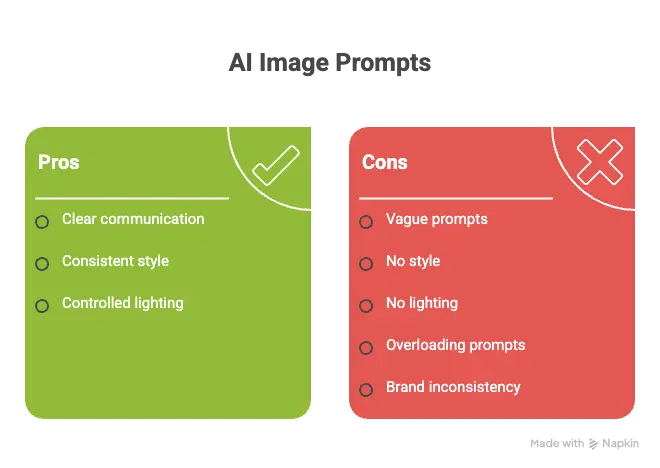
Chat GPT candid photo creation prompts
- A beautiful girl working on a laptop in a cafe, candid moment, soft, natural light coming through the window, relaxed mood, cinematic photography style.
- A tourist in Nepal standing on a mountain viewpoint, wind in hair, candid natural pose, sunrise background, ultra-realistic style.
- A candid street photo of a person crossing a road in the busy city of Kathmandu, with motion blur, natural light, and a documentary-style look.
Best AI Tools for Graphic Design
- PIKTOCHART
- Pomeilli
- LoveArt AI
- Napkin AI
- Canva AI
- Adobe Firefly
- Chat GPT candid photo creation
8. Use AI Tools for Video Marketing
Short videos and reels have dominated online attention recently. AI tools can turn text into engaging videos and single images into reels or videos with voiceover very quickly.
AI can generate:
- YouTube Shorts
- Reels
- TikTok videos
- Explainer videos
- Product demos
- Client testimonials
AI Tools for Video Generation
- Sora 2 AI
- Hailuo AI (Chinese app)
- Kling 01 and 2.6 (Chinese app)
- Seedance 1.5 Pro
- WAN 2.6 (Chinese app)
- Meta AI
- Grok AI
- Flow (veo 3.1) by Google
- InVideo
- Synthesia
Also Read: Top Free AI Tools for Video Creation You Won’t Regret!
Example Prompts
- Turn a blog post into 10 short videos.
- Act as a YouTube scriptwriter. Write a full video script for the topic: ” [TOPIC]”.
- Structure:
- Hook (first 30 seconds — pattern interrupt, bold claim, or relatable story)
- Context / why this matters (30-60 sec)
- Main content (3-5 key points, each with an example or visual cue
- B-roll / visual direction notes in [brackets]
- Transition phrases between sections
- Soft pitch/value offer (natural, not salesy)
- End screen CTA + subscribe reminder
Target length: [5 / 8 / 12 minutes]. Channel niche:
[NICHE]. Tone: [TONE].
9. Use AI Tools for Paid Advertising
Paid ads become more powerful when you test faster. AI tools can generate multiple ad variations quickly.
AI can generate:
- Hooking Headlines
- Descriptions
- Call-to-actions (CTAs)
- Video ad scripts
- Retargeting messages
- Audience angles
Example Prompts
- Write 5 Facebook ads for IVF treatment targeting couples with infertility in Nepal.
AI Tools for Paid Advertising
- Jasper
- ChatGPT
- Meta Ads Library
- Meta Ads AI features
10. Use AI Tools for Email Marketing
Email is one of the highest ROI channels. AI can improve both speed and personalization.
AI can generate:
- Subject lines
- Welcome emails
- Sales promotions
- Abandoned cart recovery
- Newsletter summaries
- Re-engagement campaigns
Example Prompts
- Write a friendly welcome email for new subscribers to an ice cream brand.
- You are an email copywriter. Write a 3-email welcome sequence for a skincare brand targeting women aged 25- 40 in Nepal. Each email should have a subject line, engaging body, and a strong CTA.
- Act as an email marketing specialist. Write a 3-email welcome sequence for new subscribers to [NEWSLETTER/BRAND NAME].
- Email 1 — Immediate (sent right after signup):
- Warm welcome + what to expect
- Quick-win tip or freebie delivery
- Set expectations (frequency, content type)
Email 2 — Day 3: - Your brand story/founder note
- Social proof (testimonials, community size, press)
- Invite to reply/engage Email 3 – Day 7:
- Best of your content (top 3 resources)
- Soft CTA to a paid product, community, or call
Subject lines + preview text for all 3. Tone: [TONE]. Brand voice: [DESCRIBE].
AI Tools for Email Marketing
- Mailchimp AI
- HubSpot AI
- Jasper
11. Use AI Tools for Customer Support
Customer support is one of the most important parts of any business. Fast replies improve trust and conversions.
Today, AI tools help companies respond faster, reduce workload, improve customer satisfaction, and provide 24/7 assistance.
AI can generate:
- Customer replies
- FAQ generation
- Email responses
- Live chat support
- Complaint handling
- Order tracking
- Appointment booking
- Basic troubleshooting
- Lead qualification
- Follow-up email
Example Prompts
- Write a polite customer support reply for delayed product delivery.
- Generate an automated support response for password reset requests.
- Create a customer support message explaining the refund processing time politely.
- Write a chatbot reply for customers asking about shipping time.
- Generate troubleshooting steps for customers unable to log into their accounts.
- Write a friendly follow-up email after resolving a customer issue.
AI Tools for Customer Support
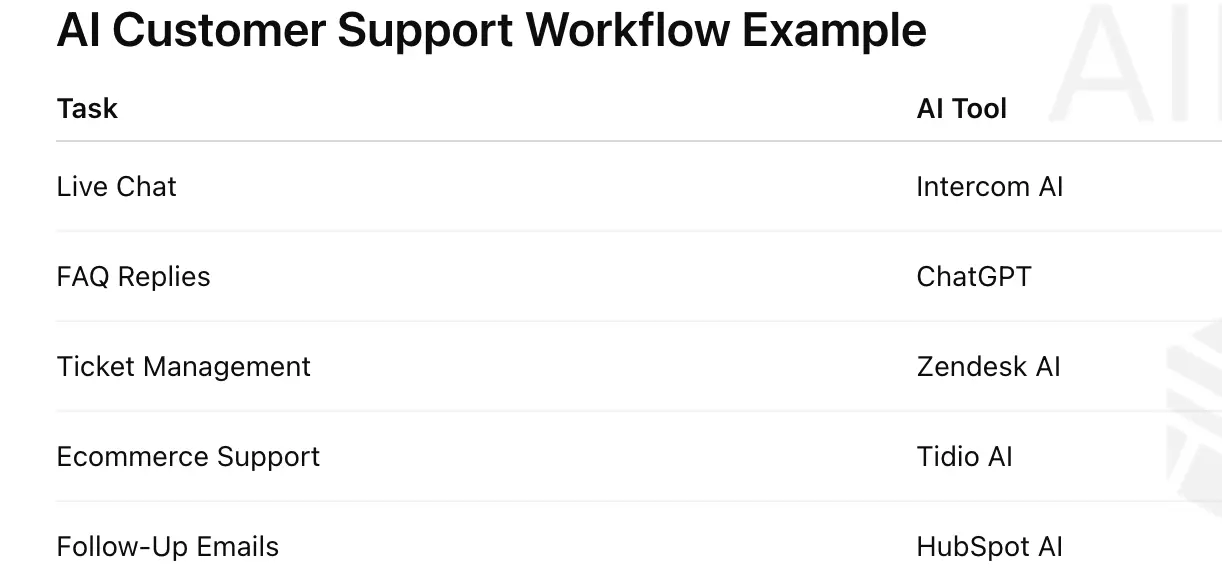
- Intercom AI – Best for AI Chatbots
- Freshdesk AI – Best for Smart Ticketing
- Tidio AI – Best for Small Businesses
- ChatGPT – Best Overall AI Support Assistant
- HubSpot AI – Best for CRM Support
12. Use AI Tools for Analytics and Reporting
Analytics AI tools help businesses track performance, understand customer behavior, and make smarter marketing decisions faster.
AI can generate:
- Performance summaries
- Traffic trends
- Conversion insights
- Customer segmentation
- ROI analysis
- SEO Report
- Campaign summaries
Example Prompts
- Create a monthly SEO performance dashboard.
- Analyze top-performing pages from last month.
- Generate an Instagram engagement report.
- Generate a keyword ranking report for my website.
AI Tools for Analytics and Reporting
13. Use AI Tools for Competitor Analysis
You should know what your competitors are doing well. AI can summarize competitor strengths quickly. It helps businesses understand what competitors are doing, identify opportunities, and improve marketing strategies faster.
AI can generate:
- Keyword gap reports
- Backlink insights
- Ranking comparisons
- Competitor keyword data
- Viral content insights
- Trending topics
- Influencer analysis
- Traffic sources
- Market trends
- SWOT analysis
- Competitor summaries
- Marketing strategy ideas
Example Prompts
- Analyze competitor keywords and backlink strategy.
- Generate competitor SEO performance report.
- Analyze the strengths and weaknesses of the top digital marketing agencies.
- Find top-performing content in digital marketing.
AI Tools for Competitor Analysis
14. Use AI Tools for Influencer Marketing
Influencer campaigns are easier when you find relevant creators. AI tools help businesses find the right influencers, analyze engagement, and manage campaigns more effectively.
AI can generate:
- Identifying niche influencers
- Reviewing engagement quality
- Creating outreach messages and emails
- Campaign captions
- Partnership ideas
- Campaign reporting
Example Prompts
- Identify beauty influencers with high followers in Nepal.
- Generate influencer campaign performance report.
AI Tools for Influencer Marketing
15. Use AI Tools for Productivity and Team Operations
Marketing success also depends on internal systems. AI helps organize teams and tasks.
AI can generate:
- Meeting summaries
- SOP creation
- Task planning
- Brainstorming
- Content approval workflows
AI Tools for Productivity and Team Operations
- ClickUp AI
- Notion AI
- Napkin AI
AI Marketing Strategy Example
Example: a skincare brand in Nepal using AI for one month.
- Research (Day 1–2): ChatGPT builds 3 buyer personas + lists customer pain points.
- Planning (Day 3): ChatGPT/Notion AI generates a 30-day content calendar.
- SEO (Day 4–5): Semrush finds keywords; Claude writes optimized blog outlines.
- Content (Week 2): Claude drafts blogs; Canva AI designs posts; all human-edited.
- Ads & email (Week 3): ChatGPT writes 5 ad variations + a 3-email welcome flow.
- Analytics (Week 4): Looker Studio + Metricool summarize what worked, feeding next month.
Result pattern: a 2-person team ships a full-funnel campaign in the time one person used to spend on content alone.
Common Mistakes to Avoid Using AI Tools
- Publishing Raw AI Content: Always edit.
- Using Too Many Tools: Start with 2–3 tools.
- No Strategy: Tools do not replace goals.
- Ignoring Brand Voice: Customize outputs.
- No Tracking: Measure what works.
Best Free AI Tools Comparison by Budget
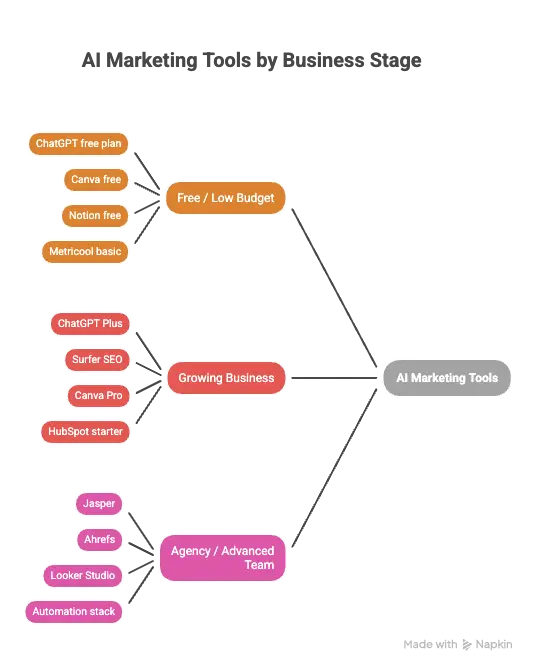
| Budget | AI Tools |
|---|---|
| Free / Low Budget | ChatGPT free plan Canva free Notion free Metricool basic |
| Growing Business | ChatGPT Plus Surfer SEO Canva Pro HubSpot starter |
| Agency / Advanced Team | Jasper Ahrefs Looker Studio Automation Stack |
How to Write Better AI Prompts
Weak Prompt
Write a post.
Strong Prompt
Write a professional LinkedIn post for a digital marketing agency helping small businesses in Nepal. Tone should be expert but friendly.
Formula
Task + Audience + Goal + Tone + Length + Platform
Conclusion
AI tools are not magic buttons. They are force multipliers.
Used correctly, they help businesses create better content, run faster campaigns, reduce costs, and improve performance.
The smartest companies do not ask:
“Should we use AI?”
They ask:
“How can we use AI strategically before competitors do?”
Start small. Choose one problem. Use one tool. Build systems. Improve monthly. That is how AI becomes real business growth.
Frequently Asked Questions (FAQs)
What is the best AI tool for marketing strategy?
Overall, with my own experience, ChatGPT is the best AI tool for marketing strategy to do any tasks like planning, content, and ideation.
Which AI tool is best for SEO?
From my experience, Semrush, Ahrefs, Surfer SEO, and ChatGPT are some of the best AI tools for SEO. I used Semrush for keyword research, planned my blog using primary and secondary keywords, and then used ChatGPT to write the content with a few human edits. After publishing, the blog surprisingly ranked in the 4th position on Google.
Can small businesses use AI?
Yes. AI is especially helpful for small business teams with limited budgets. Some of the tools, like ChatGPT, Claude, and Gemini, are still providing a free plan with limitations.
Is AI content good for SEO?
Yes, AI content can be good for SEO, and AI-written content can rank well on Google if it is high-quality, helpful, human-edited, and properly optimized. Tools like ChatGPT can speed up content creation, but adding human editing, SEO optimization, and real insights gives the best results.
Should I automate everything?
No. Automate repetitive tasks, not relationships or strategic thinking.
How can AI be used in marketing?
AI can be used in marketing for research, content writing, SEO, paid ads, social media, email, customer support, and analytics. Start with one task — like generating blog outlines or ad variations — then expand into a repeatable workflow as results prove out.
What are the best free AI tools for marketing strategy?
The best free AI tools for marketing strategy are ChatGPT (free plan), Claude, Google Gemini, Canva, Google Trends, NotebookLM, and Metricool’s free tier — covering research, content, design, and basic analytics at no cost.
What are the best AI marketing tools for small businesses?
For small businesses, ChatGPT, Canva AI, Metricool, Tidio AI, and Mailchimp AI cover content, design, social, chat, and email affordably enough to run a full marketing strategy without a large team.
- What Is Viral Marketing? Strategy, Examples & the 2026 Playbook
- SEO Automation Tools That Save Hundreds of Hours
- Top 10 Free AI Video Generation Tools: How to Write AI Video Prompts Like a Pro
- LinkedIn Lead Generation: The Complete Guide for Generating High-Quality Business Leads in 2026

Popular Post
![[2026 Updated] Top 10 Digital Marketing Agencies in Nepal Ranked!](https://mysticrubs.com/wp-content/uploads/2022/05/top-10-digital-marketing-company-in-nepal.png)



100% Best FREE SEO TOOLS 2026 for SEO Ranking
5 years ago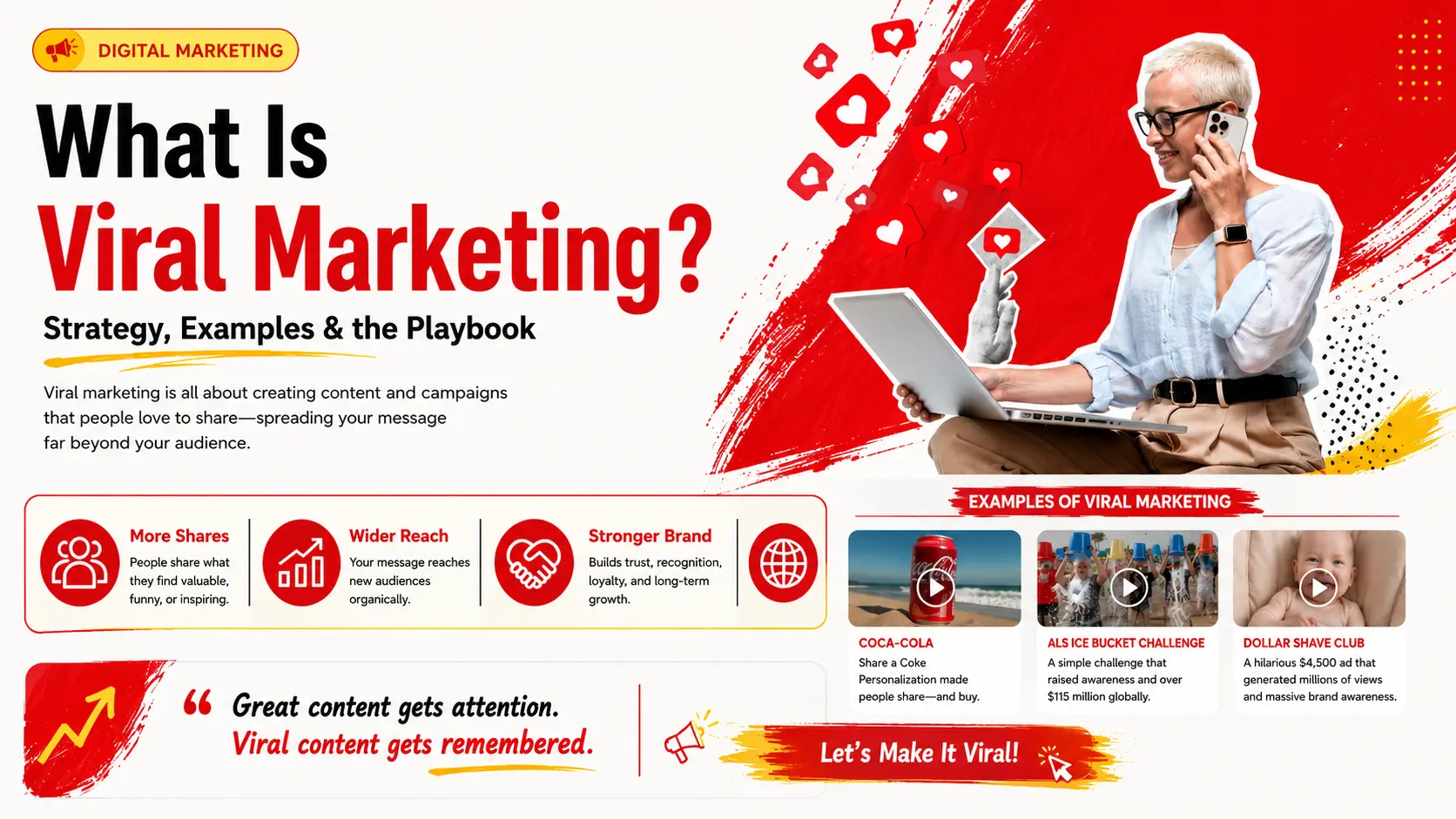
SEO Automation Tools That Save Hundreds of Hours
4 weeks ago